Problem
Case study / v0.5.0 released local-first prototype
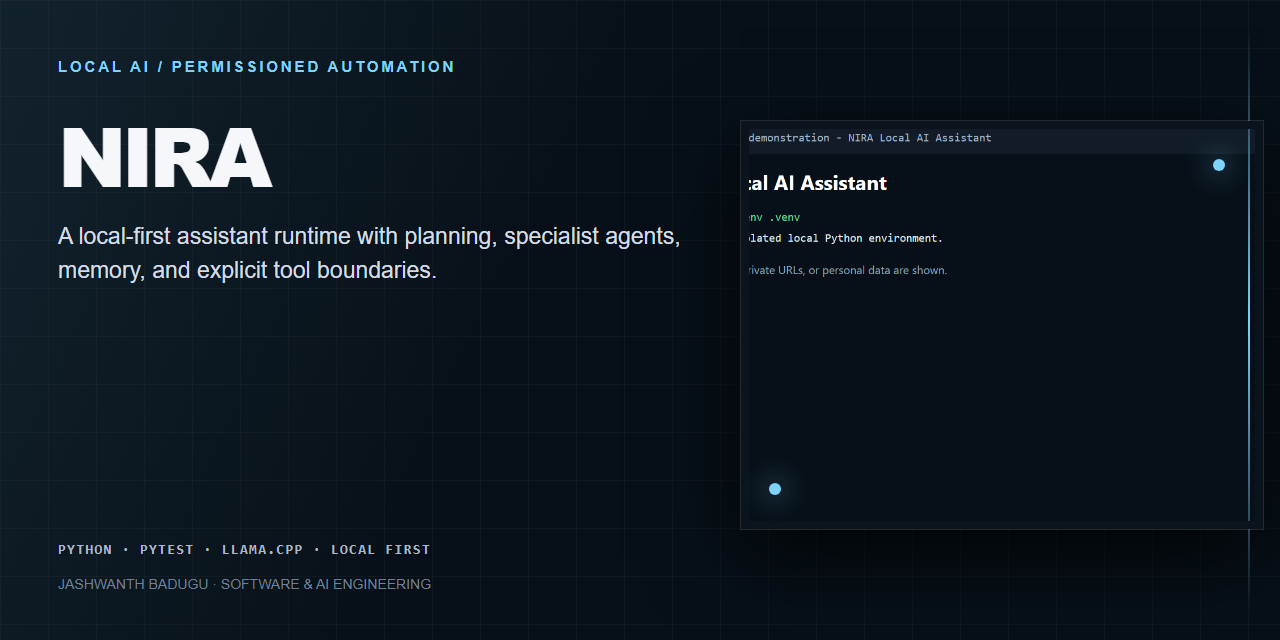
NIRA
A local-first assistant runtime with permissioned tools, planning, memory controls, and fallbacks.
Target user
Developers and operators exploring local, permissioned assistant workflows.
Solution
A modular Python runtime that plans work, routes to specialists, confirms sensitive actions, manages memory, and can use local llama.cpp inference when configured.
Personal contribution
Built the orchestration and permission model, tool and fallback boundaries, local-model integration path, test suite, documentation, and case study.
Architecture
Boundaries before buzzwords.
- Planner and specialist agents
- Permissioned tool adapters
- Memory and configuration boundary
- Optional local inference server
Main workflow
State moves with a reason.
- 01
Parse an operator goal
- 02
Plan bounded steps
- 03
Request permission for sensitive tools
- 04
Execute or recover
- 05
Store only allowed context
Technical decisions
The trade-offs that define the system.
- Local-first paths remain optional and explicit
- Tools fail clearly when their runtime is unavailable
- No unrestricted autonomous action
Difficult engineering challenge
The central challenge was making tool use useful without hiding permission decisions or treating an unavailable local model as success.
Verification
Evidence and boundaries.
Testing
- 51 pytest tests
- Isolated wheel install and CLI verification
Security and privacy
- Explicit permission checks
- Provider and OS tools are environment-dependent
Known limitations
- No verified real local-model profile for v0.5.0
- Windows is the only visually audited desktop platform
Focused future work
- Add repeatable local-model resource measurements
Verified demonstration
Rendered product behavior.
Loading video metadata…