Problem
Case study / v1.0.0 released simulated-provider prototype
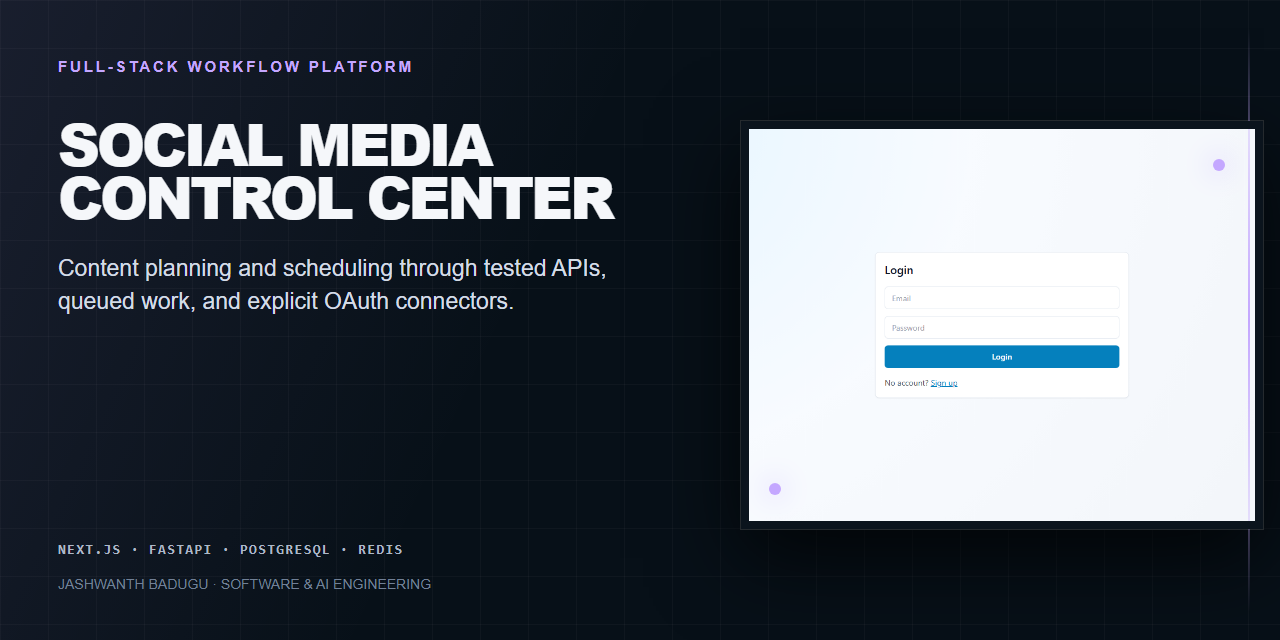
Social Media Control Center
A full-stack content workflow joining planning, scheduling, connectors, jobs, and operational state.
Target user
Small teams coordinating multi-channel content operations.
Solution
A Next.js and FastAPI control surface with connector boundaries, scheduling and worker state, explicit configuration, and safe demo behavior.
Personal contribution
Implemented the full-stack workflow, connector contract, job state and errors, web experience, API tests, documentation, and case study.
Architecture
Boundaries before buzzwords.
- Next.js static-capable operator UI
- FastAPI service and validation
- Connector abstraction
- Redis/RQ background state
Main workflow
State moves with a reason.
- 01
Compose channel-aware content
- 02
Validate connection and schedule
- 03
Queue background work
- 04
Track result or failure
- 05
Review operational state
Technical decisions
The trade-offs that define the system.
- Provider-specific logic stays behind connectors
- Absent credentials fail clearly
- Synthetic actions never imply real publishing
Difficult engineering challenge
Representing different provider capabilities without leaking provider-specific behavior through every UI and API path required a stable connector contract.
Verification
Evidence and boundaries.
Testing
- 19 API tests
- ESLint clean
- Next.js production export
Security and privacy
- Real OAuth/token handling requires provider-specific review
- No portfolio CI publishes to live accounts
Known limitations
- Live publishing is not universally verified
- End-to-end browser automation remains limited in the source project
Focused future work
- Add browser coverage for approval, schedule, and recovery
Verified demonstration
Rendered product behavior.
Loading video metadata…